
It’s 11:45 PM and you’re standing in your kitchen. The water heater is making a sound like a dying radiator, and the repair estimate on your phone just flashed a number that makes your stomach drop. You don’t have the cash in savings to cover it, and you definitely don’t want to put a four-thousand-dollar repair on a high-interest credit card that you’ll be paying off for the next three years.
This is when a personal loan stops being a theoretical financial concept and becomes a necessity. Most people don’t realize they need one until they’re staring at a broken appliance or a sudden medical bill. It’s a blunt tool, but when used right, it’s much more efficient than letting interest pile up on a credit card.
The market is crowded. You have big banks, local credit unions, and a swarm of fintech companies all shouting for your business. It feels like a lot of noise. We’ve spent time looking at how these lenders actually operate so you don’t have to guess which one fits your situation.
The Spectrum of Lenders and What They Actually Offer
Not all lenders are equal, and treating them as such is a mistake. You might think a massive bank is the safest bet, but they often have the strictest requirements. Online lenders might be faster, but they often charge a premium for that convenience. You have to decide what you’re trading: speed, cost, or accessibility.
If you need a specific amount for a home renovation, for example, you might look at Discover, which offers online personal loans ranging from $2,500 to $40,000. They are a solid middle-ground option for people who want a reputable name but prefer a digital-first application process. Then there are the tech-heavy players like SoFi or Upstart, which often use different data points to determine your creditworthiness beyond just your FICO score.
Banks like Wells Fargo offer a different vibe entirely. Their approach is often more integrated into your existing banking relationship. If you already have a checking account there, the process might feel more seamless, even if the interest rates don’t always beat the aggressive fintech startups. It’s a trade-off between convenience and the absolute lowest APR.
Here is how the landscape is currently split up:
- Traditional Banks: Usually have the best rates for people with impeccable credit, but they are slower and have rigid criteria.
- Credit Unions: Often have the most consumer-friendly terms because they are non-profit, though their digital tools might feel a bit dated.
- Online Lenders: The kings of speed. You can often get an answer in minutes, but the interest rates can climb quickly if your profile isn’t perfect.
- Alternative Lenders: These companies often look at “alternative data” (like your utility payment history) to help people with thin credit files.
It’s a lot to take in. One wrong move can mean paying an extra $500 in interest over the life of the loan. Don’t rush. Take a breath.
Decoding Interest Rates and The True Cost of Borrowing
Everyone talks about the APR, but few people actually do the math on the total cost of the loan. An APR is the “Annual Percentage Rate,” and it includes both the interest and any upfront fees you might be paying to get the money. If a lender tells you the rate is 6%, but they also charge a 5% origination fee, your actual cost is much higher than that 6% sounds.
We recently saw a scenario where a borrower, let’s call him Mark, needed $15,000 to consolidate some old debt. He was quoted a 12% APR from one lender, but when he looked at the fine print, there was a $900 origination fee taken straight out of the loan amount. He only actually received $14,100 in his bank account, but he still owed interest on the full $15,000. That is a massive hidden cost that catches people off guard.
To avoid this, you need to compare “apples to apples.” When you use a comparison tool like NerdWallet to look at rates from SoFi or Upgrade, make sure you are looking at the total cost, not just the headline number. A lower monthly payment isn’t always better if it means you are extending the loan term to five years instead of three.
The following table shows how the term length changes your monthly burden and total interest paid:
| Loan Amount | Term Length | Monthly Payment | Total Interest Paid |
| $10,000 | 24 Months | $460 | $640 |
| $10,000 | 36 Months | $325 | $1,700 |
| $10,000 | 60 Months | $212 | $2,720 |
The math is brutal. That extra $2,000 in interest in the 60-month option is money that could have stayed in your retirement account or gone toward your next big goal. Borrowing for the shortest term you can afford is almost always the smartest move. It is the most effective way to minimize the “rent” you pay on someone else’s money.
Credit Scores and The Myth of the “Hard Inquiry”
The biggest fear most people have when applying for a loan is “ruining their credit.” There is a massive difference between a “soft pull” and a “hard pull.” Understanding this is the difference between a smart shopping trip and a credit score disaster. Most modern lenders allow you to “check your rate” without affecting your score at all.
When you use a service like Wells Fargo to check your options, they typically perform a soft inquiry. This is essentially a quick peek at your credit report that doesn’t leave a permanent mark. It’s a low-risk way to see if you are even in the running for the rates you want. You should always do this first. If you start blasting out full applications to five different banks, you will see a series of hard inquiries on your report, which can actually lower your score temporarily.
If you find a lender through a platform like Jetzloan or any other aggregator, use that to shop around while the stakes are low. Once you see a rate you actually like, then, and only then, should you proceed to the formal application that involves a hard inquiry. It’s a two-step dance. Do not skip step one.
Your credit score is your financial reputation. If you need to build it, look for lenders that specialize in “credit builder” products. However, if you already have a high score, don’t be afraid to be picky. High-score borrowers have the most leverage. You can demand better terms, lower fees, and more flexible repayment schedules. If a lender won’t budge on a high origination fee despite your 780 FICO, walk away. There are better options out there.
Strategic Debt Management and Avoiding the Trap
A personal loan is a tool, but like any tool, it can be misused. The most common “correct” use is debt consolidation. If you have $12,000 sitting on a credit card with a 24% interest rate, taking out a personal loan at 11% to pay it off is a massive win. You are effectively cutting your interest expense in half and turning a revolving debt into a structured, monthly payment. This is where a loan actually works for you.
The danger is when people use a personal loan to pay off a credit card, and then, within six months, they start using that credit card again. This is the “double debt” trap. Now you have the original personal loan payment *and* a new credit card balance. You have effectively doubled your debt instead of consolidating it. This is how people end up in a cycle of borrowing that is incredibly difficult to break. It is a hole that gets deeper every time you reach for the plastic.
You need a plan before you sign the paperwork. If you are consolidating, you have to be disciplined enough to not run up those balances again. Some people find it helpful to actually close the credit card accounts after paying them off, though that can sometimes impact your credit age. A better way is to simply hide the cards in a drawer and commit to a strict budget. The loan solves the math problem, but it does not solve the behavior problem.
Consider these scenarios for using a loan:
- The Home Repair: You need $5,000 for a roof. A loan provides a fixed term and a lower rate than most credit cards.
- The Debt Shuffle: You have three high-interest cards. One loan merges them into one payment with a lower APR.
- The Life Milestone: You are getting married or moving. A loan provides a lump sum of cash for immediate, one-time expenses.
Watch your spending. A loan is not a raise; it is a temporary advance on your future income. If you treat it like “free money,” the interest rates will ensure you regret it very quickly. Treat every dollar borrowed with a healthy dose of skepticism.
Check your credit report for errors before you apply.
Quick answers
What are the different types of personal loan options available?
Common options include unsecured personal loans, which require no collateral, and secured personal loans, which are backed by assets like savings or property.
How do personal loan services determine my interest rate?
Lenders typically base interest rates on your credit score, income level, debt-to-income ratio, and employment history.
What is the difference between a fixed-rate and a variable-rate personal loan?
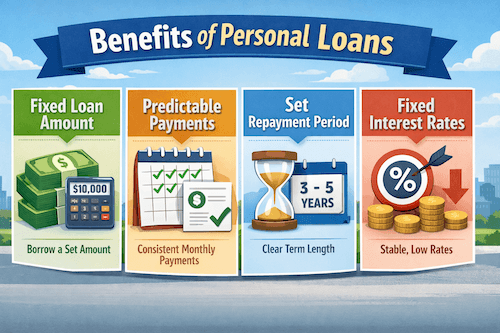
Fixed-rate loans have consistent monthly payments throughout the term, while variable-rate loans feature interest rates that can fluctuate over time.
Can I use a personal loan to consolidate debt?
Yes, many personal loan services offer debt consolidation loans specifically designed to combine multiple high-interest debts into a single monthly payment.
Are there fees associated with taking out a personal loan?
Fees can vary by lender but may include origination fees, application fees, or prepayment penalties for paying the loan off early.